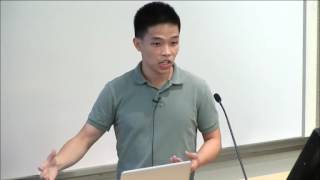
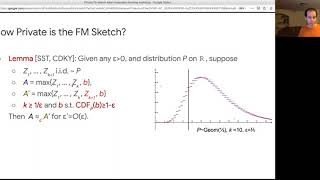
Media Summary: A Google TechTalk, presented by Abhradeep Guha Thakurta, 2020/0814 Full Title: ( Machine Learning in Finance Workshop: 2020 Virtual Edition Hosted by Bloomberg, The Fu Foundation School of Engineering ... Paper by Pasin Manurangsi, Akshayaram Srinivasan, Prashant Nalini Vasudevan presented at Crypto 2020 See ...

Nearly Optimal Algorithm For Private - Detailed Analysis & Overview

A Google TechTalk, presented by Abhradeep Guha Thakurta, 2020/0814 Full Title: ( Machine Learning in Finance Workshop: 2020 Virtual Edition Hosted by Bloomberg, The Fu Foundation School of Engineering ... Paper by Pasin Manurangsi, Akshayaram Srinivasan, Prashant Nalini Vasudevan presented at Crypto 2020 See ... In this work we show that for any mechanism design problem with the objective of maximizing social welfare, the exponential ... Recent work of Erlingsson et al (2019) demonstrates that random shuffling amplifies differential privacy guarantees of locally ... Speaker: Alireza Fallah, Massachusetts Institute of Technology Date: July 29th, 2022 Abstract: ...

We present a deterministic comparison-based Speaker: Robert Kleinberg, Cornell University Friday, September 26th, 2025 ... Talk by Hanna Komlos, joint work with Michael A. Bender, Alex Conway, Martin Farach-Colton, Michal Koucky, William Kuszmaul ... Speaker: Audra McMillan (Apple) Title: Hiding among the clones: a simple and A Google TechTalk, 2020/7/29, presented by Adam Smith, Boston University ABSTRACT: We show that a classic A Google TechTalk, presented by John Duchi, 2023-02-08 Privacy ML series. ABSTRACT: We design an (ε,δ)-differentially

The results of learning and statistical inference reveal information about the data they use. This talk discusses the possibilities and ... Today, we having Abhradeep Guha Thakurta and Om Thakkar. Abhradeep Guha Thakurta is a senior research scientist at Google ... But that does not mean we can get-- what our Amnon Ta-Shma, Tel Aviv University Proving and Using ...

Photo Gallery

(Nearly) Optimal Algorithm for Private Online Learning
Emily Diana: Optimal, Truthful, and Private Securities Lending
Nearly Optimal Robust Secret Sharing against Rushing Adversaries
The Exponential Mechanism for Social Welfare: Private, Truthful, and Nearly Optimal
Vitaly Feldman: A Simple and Nearly Optimal Analysis of Privacy Amplification by Shuffling
Optimal and Differentially Private Data Acquisition: Central and Local Mechanisms
Michal Opler: An Optimal Algorithm for Sorting Pattern-Avoiding Sequences
Jinya Lin, Univ. of Hong Kong,  Optimal Differentially Private Algorithms for k-Means Clustering
PODS22 A Nearly Instance-optimal Differentially Private Mechanism for Conjunctive Queries
Near-Optimal Algorithms for Omniprediction
FOCS 2024 Nearly Optimal List Labeling
TCS+ Talk: Audra McMillan (Apple)
Sponsored
Sponsored
View Detailed Profile
(Nearly) Optimal Algorithm for Private Online Learning

(Nearly) Optimal Algorithm for Private Online Learning

A Google TechTalk, presented by Abhradeep Guha Thakurta, 2020/0814 Full Title: (

Emily Diana: Optimal, Truthful, and Private Securities Lending

Emily Diana: Optimal, Truthful, and Private Securities Lending

Machine Learning in Finance Workshop: 2020 Virtual Edition Hosted by Bloomberg, The Fu Foundation School of Engineering ...

Sponsored
Nearly Optimal Robust Secret Sharing against Rushing Adversaries

Nearly Optimal Robust Secret Sharing against Rushing Adversaries

Paper by Pasin Manurangsi, Akshayaram Srinivasan, Prashant Nalini Vasudevan presented at Crypto 2020 See ...

The Exponential Mechanism for Social Welfare: Private, Truthful, and Nearly Optimal

The Exponential Mechanism for Social Welfare: Private, Truthful, and Nearly Optimal

In this work we show that for any mechanism design problem with the objective of maximizing social welfare, the exponential ...

Vitaly Feldman: A Simple and Nearly Optimal Analysis of Privacy Amplification by Shuffling

Vitaly Feldman: A Simple and Nearly Optimal Analysis of Privacy Amplification by Shuffling

Recent work of Erlingsson et al (2019) demonstrates that random shuffling amplifies differential privacy guarantees of locally ...

Sponsored
Optimal and Differentially Private Data Acquisition: Central and Local Mechanisms

Optimal and Differentially Private Data Acquisition: Central and Local Mechanisms

Speaker: Alireza Fallah, Massachusetts Institute of Technology Date: July 29th, 2022 Abstract: ...

Michal Opler: An Optimal Algorithm for Sorting Pattern-Avoiding Sequences

Michal Opler: An Optimal Algorithm for Sorting Pattern-Avoiding Sequences

We present a deterministic comparison-based

Jinya Lin, Univ. of Hong Kong,  Optimal Differentially Private Algorithms for k-Means Clustering

Jinya Lin, Univ. of Hong Kong, Optimal Differentially Private Algorithms for k-Means Clustering

Jinya Lin, Univ. of Hong Kong,

PODS22 A Nearly Instance-optimal Differentially Private Mechanism for Conjunctive Queries

PODS22 A Nearly Instance-optimal Differentially Private Mechanism for Conjunctive Queries

A

Near-Optimal Algorithms for Omniprediction

Near-Optimal Algorithms for Omniprediction

Speaker: Robert Kleinberg, Cornell University Friday, September 26th, 2025 ...

FOCS 2024 Nearly Optimal List Labeling

FOCS 2024 Nearly Optimal List Labeling

Talk by Hanna Komlos, joint work with Michael A. Bender, Alex Conway, Martin Farach-Colton, Michal Koucky, William Kuszmaul ...

TCS+ Talk: Audra McMillan (Apple)

TCS+ Talk: Audra McMillan (Apple)

Speaker: Audra McMillan (Apple) Title: Hiding among the clones: a simple and

Private Algorithms with Minimal Space

Private Algorithms with Minimal Space

A Google TechTalk, 2020/7/29, presented by Adam Smith, Boston University ABSTRACT: We show that a classic

Large-Scale Private Learning, Part I

Large-Scale Private Learning, Part I

Kunal Talwar (Google) https://simons.berkeley.edu/talks/large-scale-

STACS 2021 | A Nearly Optimal Deterministic Online Algorithm for Non-Metric Facility Location

STACS 2021 | A Nearly Optimal Deterministic Online Algorithm for Non-Metric Facility Location

A

A Fast Algorithm for Adaptive Private Mean Estimation

A Fast Algorithm for Adaptive Private Mean Estimation

A Google TechTalk, presented by John Duchi, 2023-02-08 Privacy ML series. ABSTRACT: We design an (ε,δ)-differentially

DLS • Adam Smith • Privacy, Learning, and Inference

DLS • Adam Smith • Privacy, Learning, and Inference

The results of learning and statistical inference reveal information about the data they use. This talk discusses the possibilities and ...

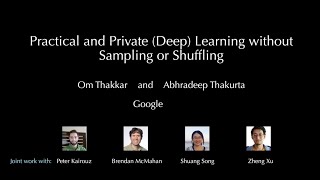
``Practical and Private (Deep) Learning without Sampling or Shuffling'' by Abhradeep G. T. and Om T.

``Practical and Private (Deep) Learning without Sampling or Shuffling'' by Abhradeep G. T. and Om T.

Today, we having Abhradeep Guha Thakurta and Om Thakkar. Abhradeep Guha Thakurta is a senior research scientist at Google ...

Noah Golowich (MIT) - Sample-efficient proper PAC learning with approximate differential privacy

Noah Golowich (MIT) - Sample-efficient proper PAC learning with approximate differential privacy

But that does not mean we can get-- what our

Explicit, Almost Optimal, Epsilon-Balanced Codes

Explicit, Almost Optimal, Epsilon-Balanced Codes

Amnon Ta-Shma, Tel Aviv University https://simons.berkeley.edu/talks/amnon-ta-shma-2017-03-07 Proving and Using ...
Related Video Content

NEARLY Definition & Meaning - Merriam-Webster information

Jun 2, 2026 · The meaning of NEARLY is in a close manner or relationship. How to use nearly in a sentence.

NEARLY | English meaning - Cambridge Dictionary information

We use almost and nearly to refer to the progress of things, especially if we are measuring and counting things. In...

NEARLY Definition & Meaning | Dictionary.com information

When something nearly happens, it comes very close to occurring, but doesn't. Nearly is a useful adverb for...

Almost vs. Nearly: What's the Difference? - Grammarly information

Almost is typically used to suggest that something is approaching a certain point or level, but is not entirely...

Nearly - definition of nearly by The Free Dictionary information

Almost and nearly both mean 'not completely' or 'not quite'. They can be used in front of adjectives or noun phrases,...